The people of Israel did not acknowledge God as their king and acted according to their own opinions. Today, if we do not acknowledge God as king, we will live by our own standards.
1. There was a man of the hill country of Ephraim, whose name was Micah. 2. He said to his mother, “The eleven hundred pieces of silver that were taken from you, about which you uttered a curse, and also spoke it in my ears, behol…
Judges 17 in Israel reveals a situation where people do not acknowledge God as their king and act according to their own desires. Through the story of a mother and her son, it shows the reality of faith being distorted into something formal and superstitious. We often do not cherish our personal relationship with God and are satisfied with merely fulfilling religious duties. We should reflect on how, even in today's churches, there are instances where God is not recognized as king and individuals act as if they are the rulers.
- Judges 17:1-3 1. There was a man of the hill country of Ephraim, whose name was Micah. 2. He said to his mother, “The eleven hundred pieces of silver that were taken from you, about which you uttered a curse, and also spoke it in my ears, behold, the silver is with me; I took it.” His mother said, “Blessed be my son of Yahweh.” 3. He restored the eleven hundred pieces of silver to his mother; and his mother said, “I most certainly dedicate the silver to Yahweh from my hand for my son, to make an engraved image and a molten image. Now therefore I will restore it to you.”
- Judges 17:6 6. In those days there was no king in Israel: every man did that which was right in his own eyes.
- Judges 17:1 1. There was a man of the hill country of Ephraim, whose name was Micah.
- Judges 17:3 3. He restored the eleven hundred pieces of silver to his mother; and his mother said, “I most certainly dedicate the silver to Yahweh from my hand for my son, to make an engraved image and a molten image. Now therefore I will restore it to you.”
- Judges 17 1. There was a man of the hill country of Ephraim, whose name was Micah. 2. He said to his mother, “The eleven hundred pieces of silver that were taken from you, about which you uttered a curse, and also spoke it in my ears, behold, the silver is with me; I took it.” His mother said, “Blessed be my son of Yahweh.” 3. He restored the eleven hundred pieces of silver to his mother; and his mother said, “I most certainly dedicate the silver to Yahweh from my hand for my son, to make an engraved image and a molten image. Now therefore I will restore it to you.” 4. When he restored the money to his mother, his mother took two hundred pieces of silver, and gave them to the founder, who made of it an engraved image and a molten image: and it was in the house of Micah. 5. The man Micah had a house of gods, and he made an ephod, and teraphim, and consecrated one of his sons, who became his priest. 6. In those days there was no king in Israel: every man did that which was right in his own eyes. 7. There was a young man out of Bethlehem Judah, of the family of Judah, who was a Levite; and he lived there. 8. The man departed out of the city, out of Bethlehem Judah, to live where he could find a place, and he came to the hill country of Ephraim to the house of Micah, as he traveled. 9. Micah said to him, “Where did you come from?” He said to him, “I am a Levite of Bethlehem Judah, and I am looking for a place to live.” 10. Micah said to him, “Dwell with me, and be to me a father and a priest, and I will give you ten pieces of silver per year, a suit of clothing, and your food.” So the Levite went in. 11. The Levite was content to dwell with the man; and the young man was to him as one of his sons. 12. Micah consecrated the Levite, and the young man became his priest, and was in the house of Micah. 13. Then Micah said, “Now know I that Yahweh will do good to me, since I have a Levite to my priest.”
Acknowledge God as King
- The Time When Israel Had No King
- A Mother's Misguided Love
- Micah's Distorted Faith
- The Corruption of the Young Levite
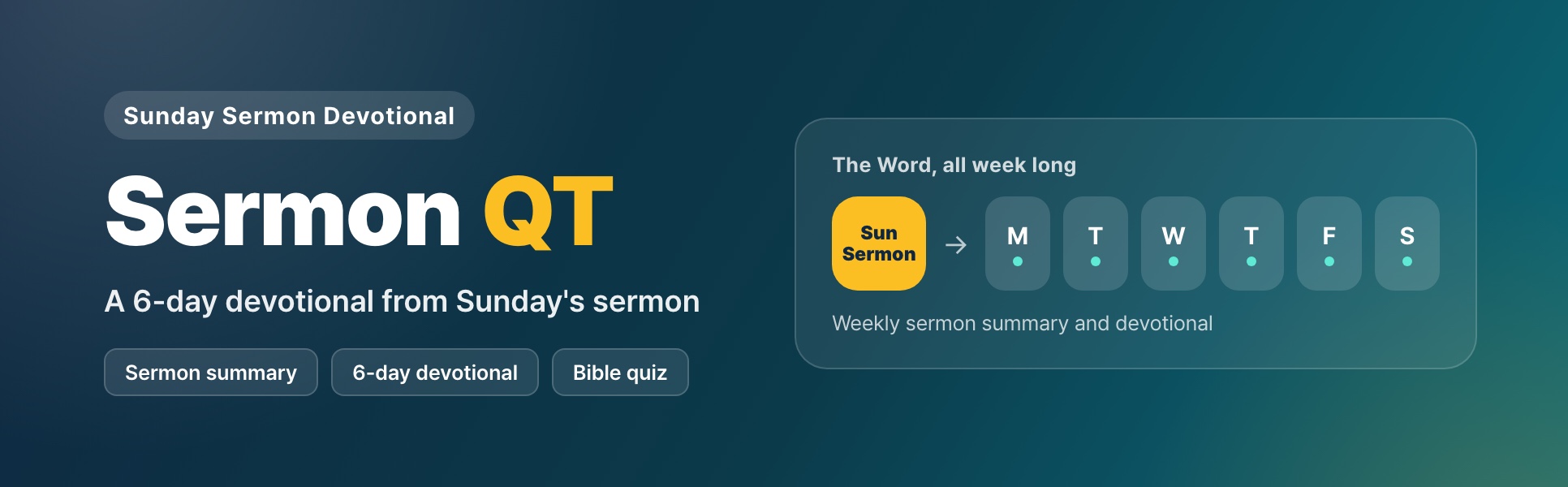
Six days of devotions drawn from this Sunday's sermon — one for each day, Monday through Saturday.
Five quick questions from this Sunday's message. Tap an answer to see if you're right.
-
What does it mean that there was no king in Israel in Judges 17?
The absence of a king in Israel means that God was not recognized as king and everyone acted according to their own views.
Amen. Today the weather is extremely hot. Yes, we have been following the book of Judges, and just like the sweltering weather, it feels a bit suffocating and stifling as we enter chapter 17 of Judges. Up to chapter 16, we have seen the stories of 12 judges explaining the situation of Israel, but now from chapter 17 to chapter 21, we are reaching the conclusion. In a sense, can we call this a summary? We have already discussed the stories of the 12 judges up to chapter 16, and now chapters 17, 18, 19, 20, and 21 serve to add to and emphasize that content, especially chapter 17.
At the beginning of today’s passage, verse 6 states, Judges 17:6, "In those days there was no king in Israel; everyone did what was right in his own eyes." Interestingly, the last verse of chapter 21, Judges 21:25, ends with the same statement: "In those days there was no king in Israel; everyone did what was right in his own eyes." The phrase "what was right in his own eyes" indicates that people acted according to their own judgment.
Friends, the statement that there was no king in Israel does not imply a hope for a monarchy or a need for one; rather, it signifies that the theocracy was not realized. God had never ceased to be the king among Israel. There has never been a time when Israel lacked a king. The statement that there was no king in Israel is nonsensical. The king of Israel has always existed, but the people did not acknowledge Him as their king. This means that each individual acted as their own king. The theocratic governance, where God rules as king over each individual, was not realized.
Leave your email to unlock Tuesday–Saturday devotionals, the full transcript and quiz free for 4 weeks. The weekly sermon email keeps coming after that.
Already subscribed? Sign inUnsubscribe anytime from the link in each email. Already subscribed? Open the link in your email.
